Join the LinkedIn Public Group – NextOps: Dev, Cloud & Intelligence to connect with professionals, share knowledge, ask questions, and grow together.

Agent Harness: The Engine Behind Multi-Step AI Execution
The post explains how an agent harness acts as the runtime layer around a model, enabling tools, memory, and control loops for multi-step execution. It highlights that the harness guides model behavior in a structured way but does not guarantee correctness, which depends on prompts, models, and tools. It also breaks down key concepts like control loops and memory, showing how they transform simple prompting into goal-driven, agentic workflows.
AISHORT WRITING
Madhubanti Jash
5/3/20262 min read
From Model to Action: The Power of an Agent Harness
Agent harness in simple term:
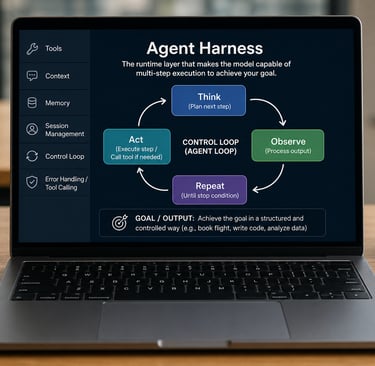
Agent harness is runtime layer around model - the layer with tool + context + memory + session management + error handling/control loop/tool calling.
The runtime layer makes the model capable of executing multi-steps.
You have a model and now you want to achieve something - be it assistance in coding or booking flight or anything else - model harness guides and influences model behaviour to reach your goal in your structured and controlled way (it guides you, but does not guarantee compliance or correctness - the correctness is dependent on boundary-setting, governance control in place).
What do I mean by it only guides but does not guarantee correctness?
Remember the accuracy of the executed result is not guaranteed by harness itself, it depends on quality of prompts, model quality, and tools used.
Now you can write this harness code around model by yourself or you can take help of some frameworks like Strands Agents SDK or you can take help of some managed Harness service like Amazon Bedrock AgentCore.
The key term "Control Loop":
Control loop is what differentiates between simple prompting/one-time answer and making the model capable of multi-step execution.
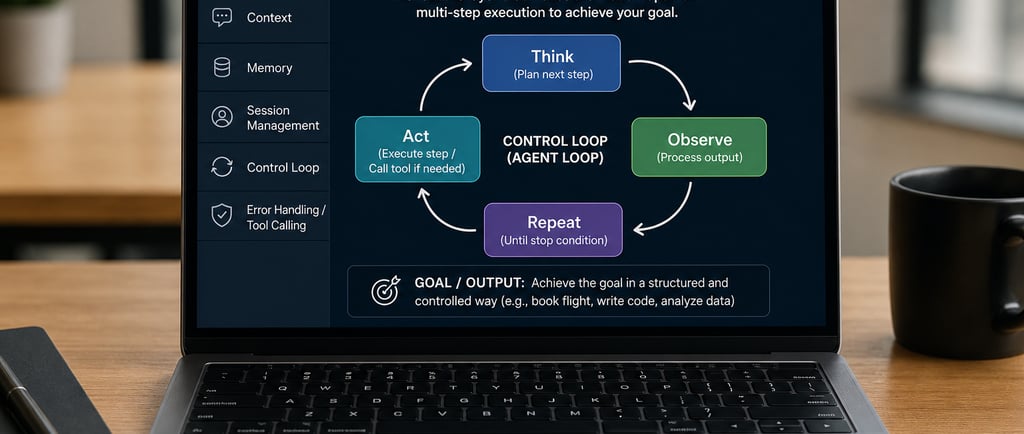
Think (plan next step), Act (execute the step and generate output), Observe (process the output), and repeat until done (depends on your stop condition).
One of the ways to implement control loop is "ReAct" (Reasoning + Act).
Remember about Control Loop:
Control loop may or may not involve tool.
In one sentence, Control loop is an iterative process where, based on the need for task planning/execution, tools can be called or reasoning is done internally without involving any tool.
This process may be followed by model multiple times (based on the need for task completion) and keeps the state updated.
Control loop is also called agent loop.
Based on stop condition, the loop ends.
What is the role of memory?
There are two types of memory:
short memory (within harness)
Short memory exists within control loop, active in one session.
Suppose you want to book flight - it will make note of date, flight destination, and results from previous tool execution in the same session.
long memory (persistent storage, external to harness)
Long-term memory is persisted in database, keywords are retrieved via semantic search, for example via RAG.
For example, it checks for your previous preferences, morning flight, breakfast included.
Examples of system which includes harness:
Codex and Claude Code are considered coding assistant systems which include harnesses (a specialized type of agent harness).
Take Away:
In simple terms, Agent Harness is what implements agentic model, not just chatbot like simple prompting.
Governance while using Agent Harness is enforced by policy engines, content filtering, business rules, boundary setting on tool calling with permitted input types, and control loop constraints (stop conditions, max steps, retries).
This governance is applied both inside and outside of the harness (outside of the entire agent runtime).
Conclusion:
Harness is a concept itself which you implement through context + tooling + control loop + memory.
Harness is not just components, but how these components are orchestrated at runtime.